“IT WAS ALWAYS A DREAM, UNTIL NOW”
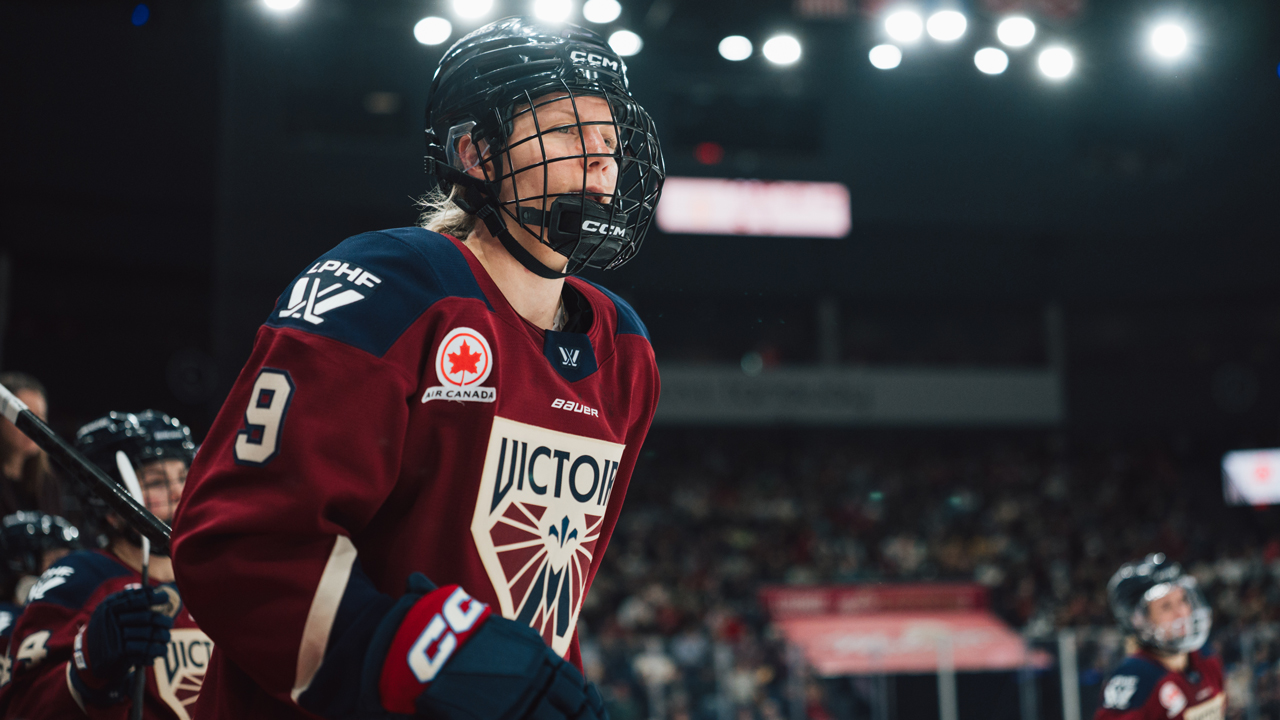
W hen Kati Tabin found out she’d made Canada’s Olympic women’s hockey team, the first thing she felt was disbelief and, as a direct result, the first two words out of her mouth were: “Holy shit!”
Tabin’s shock at being included among 23 players tasked with defending the Olympic gold medal Canada won four years ago had nothing to do with her skill level. Over the last two-and-half seasons with the PWHL’s Montreal Victoire, Tabin has established herself as one of the best defenders in the world, even if she’s not flashy about it. The thing is, though, she’s 28 years old and had just two games with the senior national team under her belt before the Olympic roster was selected. So, while she tried to remain confident and positive, she gave herself a 50-50 chance of cracking the veteran-laden Olympic team that includes household names like Captain Marie-Philip Poulin, Sarah Nurse and Renata Fast.
As reality sunk in that she’d be joining them in Milan, Tabin jumped up and down and paced her living room. She called family and friends to share the news, her mom screaming the loudest of all. But in the midst of that celebration, there was one person Tabin wanted to call, but couldn’t. Someone she would’ve thanked, if only she could have.
Back in 2022, Tabin was working as a coach and not playing at the highest level when her “world was completely shaken up,” as she puts it. Then 24, she had to navigate the most heartbreaking loss she’d ever experienced, a senseless tragedy that touched her and so many she knew and loved. Part of how she coped was by returning to professional hockey, and there is no doubt in her mind that the devastation she felt spurred her to new levels as she went after her career on ice.
Now, the second-oldest rookie to debut for the Canadian women’s team at a major international event, Tabin is proving that her hard-fought and at times tearful resilience has paid off, leading her to this biggest triumph yet. As much as the achievement itself, the way she got to this moment is why her Victoire and Team Canada teammate Erin Ambrose is so excited to see her fellow defender selected to play on the Olympic stage: “Just, I think, because of Tabes’s journey.”
W hen Tabin was growing up in tiny Oakbank, Man., home to some 5,000 people, the talk of the town was Brett Howden. “He’s going to the NHL,” darn near everyone said, and they were right, too, because Howden did make it to the league (and even won a Stanley Cup in 2023, with Vegas). Tabin heard a lot of early talk about the town’s star because she played on boys’ teams (there weren’t any girls’ hockey teams in Oakbank) and she’s one year older than Howden.
“He was always praised in our town, and I remember being so jealous about that because I thought that I was just as good as him, but obviously female-wise,” she explains, now. As she considered her own future in the game, there was no professional league for women yet in existence. “And so for me, it was the Olympics — that was always the dream,” Tabin says.
She was a fast and offensive-minded young defender and, on the advice and encouragement of her brother and uncle, she was also physical, an aspect of the game she grew to enjoy. Tabin starred on boys’ teams until the summer after Grade 6, when she played for her first girls’ team in Winnipeg, a 30-minute drive southwest from Oakbank. Soon after, she moved to the city with her mom and stepdad, in large part so she could attend Balmoral Hall. The thinking was that at the private school Tabin would get more eyes on her, upping her chances of landing a full ride to a U.S. college.
Tabin put up nearly a point per game her final season with the Balmoral Hall Blazers in the U-19 Junior Women’s Hockey League, and at 17 she played for Team Manitoba at the 2015 Canada Winter Games. But she wasn’t selected for the U-18 national development program, unlike all six other rookies suiting up for Canada at these Olympics.
She accepted a scholarship to play Div. 1 hockey at Quinnipiac University in Connecticut, and that’s when Tabin’s brand of defence started to shift. It’s also where she first drew notice from the national team development program.
“At Quinnipiac, they really nailed down on that defensive piece and having good sticks and being physical and ultimately being hard to play against,” Tabin says. “That’s really where I learned that and took ownership of my defensive game and playing that way.”
In 2018-19, her third college season, Tabin was named to her first national team, at the U-22 level, and played in a series against the U.S. that summer. “After not being invited to the U-18s, I was just pumped that my hard work had paid off,” Tabin says. A season later, she captained Quinnipiac, was again part of Canada’s U-22 team, and earned an invite to her first-ever senior national team training camp. Tabin was not only on Team Canada’s radar, she was moving up the ranks.
“I just put my head down and went to work, but I remember at those senior camps it was, like, another level,” she says. One of 14 defenders, she was released after the group’s second camp. “I was a little out of my element, I think, personally. I definitely learned a lot there, but ultimately, I don’t think I was ready.”

When Tabin’s final college season was cut short because of COVID, she decided to make use of the two degrees she’d earned and took a marketing job in Wisconsin. She wondered if her hockey career was over, but it didn’t take her long to miss the game. In the fall of 2021, while she was visiting friends in Connecticut, she tried out for and made the Premier Hockey Federation’s Connecticut Whale. Then, just six games into the season, she encountered visa issues and had to move home.
The silver lining for Tabin after that unwanted second departure from the game was finding herself back with family and childhood friends, including Jordyn Reimer, who’d become one of Tabin’s best pals after the pair met on their Grade 6 summer hockey team. They played together on club teams in Winnipeg through high school, and while Reimer had gone to college in Alberta and played for MacEwan University, she too had moved home after graduating.
“When I got back from Connecticut, we started hanging out again just like we had growing up, and it was one of those best friends that you’re away from for a while, but you hang out with once after that, and it’s like we hadn’t spent a day apart,” Tabin says.
When the PHF’s Toronto Six got in touch to see if Tabin was interested in signing there, she went to Reimer for advice.
“I’d always ask Jordyn: ‘What do you think? Should I play overseas? Should I play for Toronto? Or should I just continue to work in Winnipeg? I don’t know what to do,’” Tabin says.
Reimer’s response was always to encourage her friend to stick with hockey, to the tune of: “Just go for it! Why not?”
The pair were texting one evening, making plans for the upcoming weekend. The next day, May 1, 2022, Tabin woke up to a bunch of missed phone calls from one of her buddies in Winnipeg. He’d heard about a car accident near where they all lived; a yet-to-be-identified 24-year-old woman had been found dead at the scene.
Tabin immediately called Reimer, but couldn’t get a hold of her friend. Later that day, one of Reimer’s sisters called to tell Tabin that Jordyn had been killed by a drunk driver.
Tabin takes some deep breaths after recounting the details of that awful day nearly four years ago. “It’s terrible. Driving impaired is…” she trails off.
In the days and weeks after her friend’s death, Tabin was reeling, grieving, doing whatever she could to support the Reimer family. She eventually went back to work as a hockey coach. She wrote an impact statement for the court, detailing some of the emotional trauma caused by the accident. The driver who hit Reimer, Tyler Goodman, was later sentenced to seven years.
While she was navigating life without one of her best friends, Tabin decided to sign with the Toronto Six for the 2022-23 PHF Season. “I just felt like, ‘I really miss hockey. I feel like this will honestly be good for me to get into a team environment again, and be around a lot of good people every day,’” she says. “It was so terrible, so honestly part of the reason I wanted to start playing hockey again was, one, to just kind of get away from it all — get out of Winnipeg and get my mind off it. And, also, remembering those conversations with [Reimer]. She was always like, ‘Just go for it!’”
So Tabin did. That season in the PHF, she paced all defenders in points. Toronto Six coach Geraldine Heaney played her “basically half of every game,” recalls the team’s then- president, Sami-Jo Small. The former Team Canada goaltender, Small admits she herself wouldn’t have identified Tabin’s top-rate defensive skill had Heaney — a former national team forward — not pointed it out and played Tabin every chance she got.
“There’s really nothing flashy about what she does, but she is just really solid defensively. She makes the first pass out of the zone. She’s a smart, simple player,” Small says of Tabin. “She’s one of those players that coaches just trust against top lines. She’s dependable.”
Tabin helped lead the Six to a championship to close out the 2022-23 season, and she brought the Isobel Cup home to Winnipeg for a celebration. It was the last time the Isobel Cup was awarded, since the league was bought out by PWHL investors in June 2023.
Tabin played a big role in bringing that championship to Toronto, and she didn’t wear her usual No. 7 for the Six. Instead, she wore No. 9 — the number she still wears today for the Victoire — in honour of her best friend, Jordyn Reimer.
S hortly after the PWHL began in 2024, former Team Canada captain Cassie Campbell recalls taking notice of Tabin, who the Victoire selected 30th overall in the league’s inaugural draft.
“I think she’s one of the best defencemen in the league,” Campbell told Gina Kingsbury, who doubles as both the Toronto Sceptres’ and Team Canada’s general manager. And Kingsbury clearly didn’t disagree, eventually opting to make Tabin one of seven defenders to represent Canada at the Olympics. “She’s hard to play against. That was an attribute that we felt we needed at the back end,” Kingsbury says.
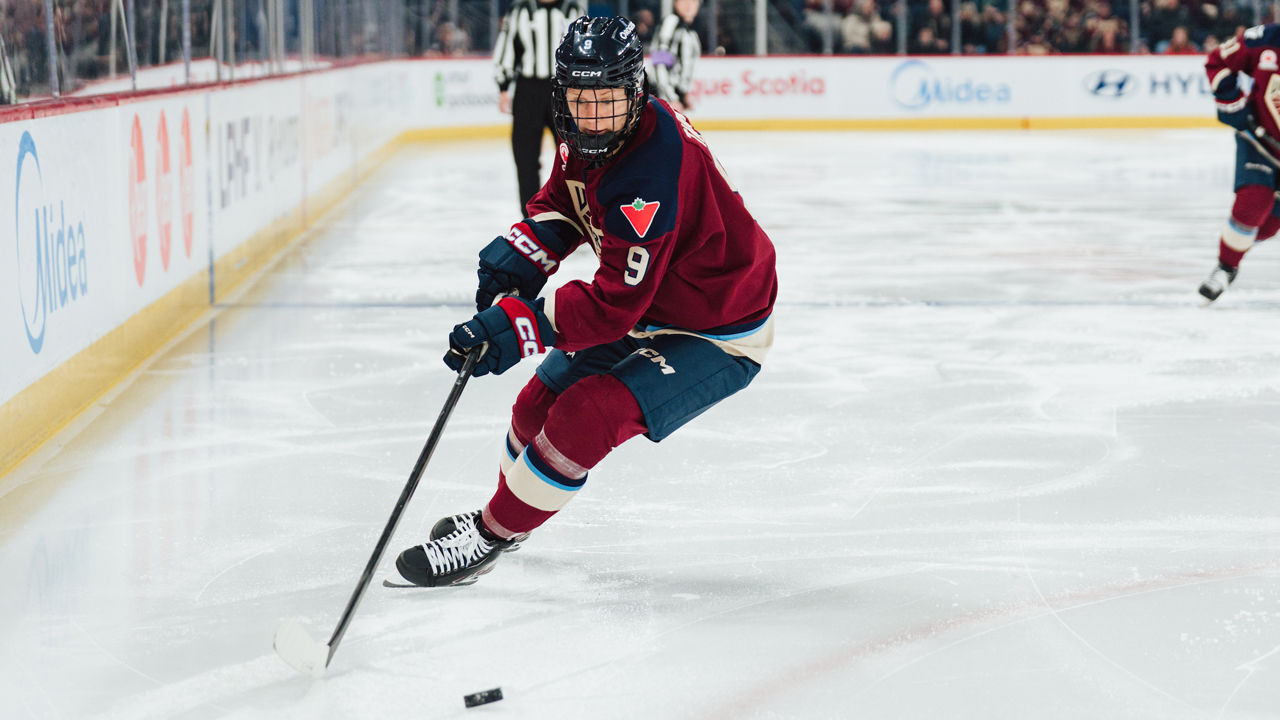
Of Canada’s blueliners, Tabin doesn’t regularly display the offensive flash of Renata Fast or Claire Thompson or fellow Olympic rookie Sophie Jaques. But she leads her Victoire in plus-minus, notable for a player who’s regularly on the penalty-kill. Montreal has given up the fewest goals league-wide this season. Having Ann-Renée Desbiens between the pipes no doubt helps, she’s the owner of the league’s best GAA, but No. 9 is another big reason why the Victoire are tough to score against.
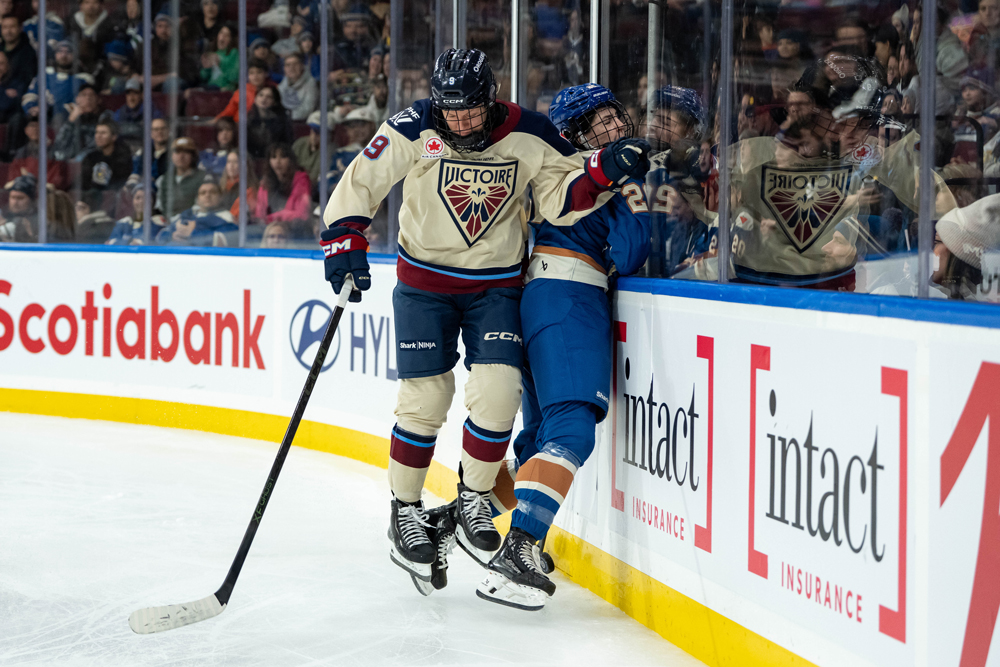
Tabin is strong, she blocks a lot of shots and lays a lot of hits — the second-most on the Victoire roster, behind only Captain Canada herself. “Oh, her physicality,” Ambrose says of what stands out most about Tabin, who was Ambrose’s regular D partner up until this season. “She finishes a lot of checks.” Yet Tabin is rarely penalized.
“I think if you talk to anybody in the league [PWHL], going up against Tabes isn’t a fun thing — it makes for a very long night for opposing players,” Ambrose explains. In Milan, she can see her Victoire teammate being deployed against Team USA, trying to limit offensive stars like Abbey Murphy, Taylor Heise, Hilary Knight and Kendall Coyne Schofield with her long reach and great positioning, and her head always on a swivel.
“I think that those things line up really well against the Americans, and her ability to defend is going to make things very hard for them,” Ambrose says. “And I think it’s a big reason why she was able to make this team.”
If you’re an opponent standing in front of Canada’s net and Tabin’s on the ice, it’s not going to be comfortable. “I usually try to make it pretty tough for someone to stand there, and [to make them] not really want to stand there anymore, honestly,” she says. “Whether that’s a couple whacks or blocking shots or having a good stick. A lot of different details in my defensive game I’ve focused on, and I think it’s just allowed me to be hard to play against. One thing I’ve really tried to focus on bringing consistently is that physicality piece, and that different kind of physicality.”
Ambrose was named the PWHL’s defender of the year in 2024, and she credits her D partner for getting her into that conversation, noting Tabin is underrated by those who don’t play with or against her.
“There’s no chance I would have been up for that award if I wasn’t playing with Tabes,” says Ambrose. “The way that she plays, she just makes my job a lot easier every time I go out on the ice with her — or for whoever goes out on the ice with her.
“She skates the game so well, like, her feet. She’s so powerful when she skates and I think that she’s getting more confident with the puck on her stick, too. I think her game, truthfully, just keeps evolving even more and more, and it’s pretty exciting to witness and to get to watch.”
You could chalk it up to a blue-collar Winnipegger mentality, but for Tabin it was a more recent shift in thinking. With only 23 roster spots for an Olympic team, or 25 for world championships, more than a few talented players come through the Team Canada development system and never make the biggest stages. Tabin, meanwhile, took a roundabout path and bumped her way onto the big roster.
“I feel like some players get satisfied with how they’re performing and they don’t, you know, maybe want to continue to put in the work and continue to get better to make that next jump,” she explains. “I don’t think I really deserved it, until over the recent years when I really put in the work and continued to get better and wasn’t satisfied with my play until I thought, ‘Okay, I’m good enough, I should be there.’”
Tabin credits regular practice against Victoire teammates like Poulin and Laura Stacey, and learning from Ambrose, as key to improving her defensive play. She asks questions and gets feedback. “Even just on power play, I’m always working on my one-timer after practice and Pou has come up to me and given me a few tips, like, ‘Hey, try this, see how that feels.’ So, yeah, it’s just awesome,” Tabin says, with a laugh. “I mean, she’s the best at what she does.”
Tabin also has regular conversations with Desbiens and says the goalie’s calm demeanour makes her feel like she has time to make the right play, instead of panicking. “And being able to talk to her like, ‘What do you want me to do different there?’ Whether that’s a shot from the blueline or on a 2-on-1,” Tabin says, noting she started cheating more to the player without the puck on 2-on-1s. “I allow her to take the shot now because that’s the easiest play for her, knowing that she’s back there and that’s what she wants.”
It’s something she does regularly for the Victoire. That she’ll now be protecting Desbiens and limiting chances on Olympic ice makes Tabin laugh. “It’s honestly crazy to think about,” she says.
In the crowd in Milan watching Tabin make her Olympic debut along with her family, will be Reimer’s mom, Karen. “That’s really special to have her there, and the whole family has been great, supporting me along the way,” Tabin says.
Tabin cries when she thinks about how Jordyn would react to seeing her at the Olympics. “I know she’d be super proud,” she says, her voice shaking.
Her journey to this point has been long and bumpy, at times both heartbreaking and joyous.
“I feel like I’ve developed a lot over the last few years, and I feel like I’m ready,” Tabin says. “It was always a dream, until now.”